An AI workflow audit examines how a specific business process runs, where time and information are lost, and whether AI is a sensible improvement. It should produce a prioritised recommendation, a clear first scope and measurable success criteria. Sometimes the right recommendation is ordinary automation or a process change instead.
What is an AI workflow audit?
An AI workflow audit is a practical review of the work behind a proposed project. It connects the business problem to the people, information and systems involved before committing to a build.
Start with a concrete issue: enquiries waiting for a response, documents being retyped or staff chasing missing details. A broad instruction to use AI does not identify which outcome needs improving. The audit turns that ambition into a decision the business can assess.
Talk to the people doing the task as well as the person sponsoring the project. Ask them to show a recent ordinary example and an awkward exception. The difference between the documented process and the actual handoffs is often where useful questions emerge.
The output should be understandable without technical knowledge. You should be able to explain what happens now, what might change and what evidence would justify spending money on it. A list of AI tools alone does not provide that explanation.
What information should you bring?
Bring representative examples, the systems involved and whatever reliable information you have about workload and outcomes. There is no need to invent a baseline if the business has not measured one yet.
Useful material could include sample enquiries, blank forms, anonymised documents, process notes and reports showing queues or completion times. Use examples you are authorised to share. Begin with sample or redacted information when customer or supplier details are unnecessary.
The review should establish:
- What triggers the work and how often it occurs.
- Which information is needed at each step.
- Where staff copy, interpret or check information.
- Who approves the result and handles exceptions.
- Which systems can exchange the required information.
- What a delay or mistake means for the business.
If reliable timings are unavailable, agree how to observe a representative sample. Separate active handling time from time spent waiting. A task can involve little effort but sit untouched between teams, requiring a different solution from faster document processing.
How should opportunities be prioritised?
Prioritise opportunities by useful business impact, feasibility and consequences of failure. The most visible frustration is worth investigating, but it is not automatically the best first project.
Compare the options using the same questions. Does the work happen frequently enough to justify maintenance? Is the input available? Can staff check the output? Is there a safe way to trial it? Would fixing a form or connection remove most of the problem?
For illustration, suppose a business is considering enquiry summaries and automatic quote approval. Summaries may offer a bounded trial where staff can compare the result with the original message. Quote approval could involve pricing, availability and contractual commitments, requiring a different level of control. This is a comparison of proposed workflows, not a client result.
Avoid treating every task involving text as an agent project. Anthropic's guidance on effective agents recommends starting with the simplest suitable solution. Its distinction between fixed workflows and flexible agents is useful when weighing options.
Your audit should make that choice explicit. An ordinary rule can route a completed form. AI may be useful for interpreting a varied message before that routing step. Combining them can be more appropriate than giving one system authority over the whole process.
What should the audit deliver?
Expect a clear recommendation and a first scope that can be tested. You should also understand the assumptions, dependencies and unresolved questions behind the recommendation.
A useful brief names the task, input, expected output, owner, review points and excluded actions. It identifies which system receives the result and what should happen if a connection fails. It also defines what must be confirmed before development begins.
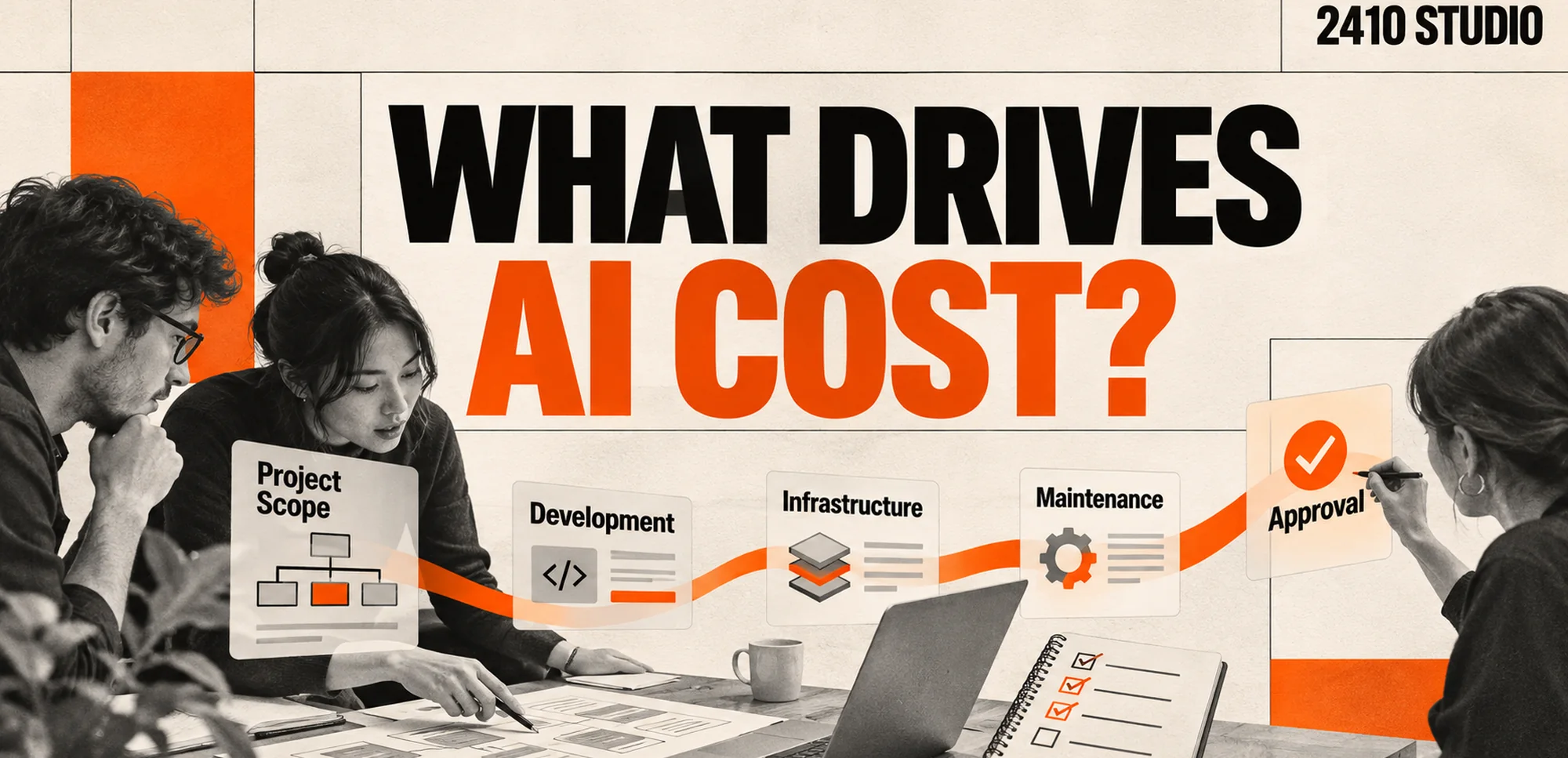
Ask for a cost breakdown rather than a single unexplained figure. Setup, software licences, usage, training, support and maintenance may be separate costs. An estimate should state what volume and functionality it assumes, with uncertainty visible where further investigation is needed.
Set success criteria around the original issue. If staff spend time retyping document details, measure the full process including review and correction. If enquiries are missed, measure unresolved items and response completion rather than how many drafts AI generates.
An audit can legitimately conclude that the business should wait. Unclear ownership, unreliable information or a changing process may need attention first. Resolving those issues creates a better foundation than automating confusion and then paying to change it.
2410 Studio is a UK studio that builds AI into the tools a business already uses, with the client keeping custom code. The studio's project portfolio shows examples of its work, while the audit focuses on what your particular workflow needs.
Frequently asked questions
Is an audit the same as a software proposal?
No. An audit should establish the problem and assess options before assuming a build is justified. A proposal then defines the recommended work and commercial terms.
Do we need complete documentation?
No. Actual examples and the people who understand the task are a useful starting point. Missing documentation should become a clear follow-up action, not an excuse to guess.
Will the recommendation always involve AI?
It should not. Better information capture, ordinary automation or a simpler handoff may address the problem more directly.
Choose one workflow you want to understand better and talk to 2410 Studio about an audit. Bring the problem, the tools involved and an example of where the work gets stuck.
START YOUR INTEGRATION