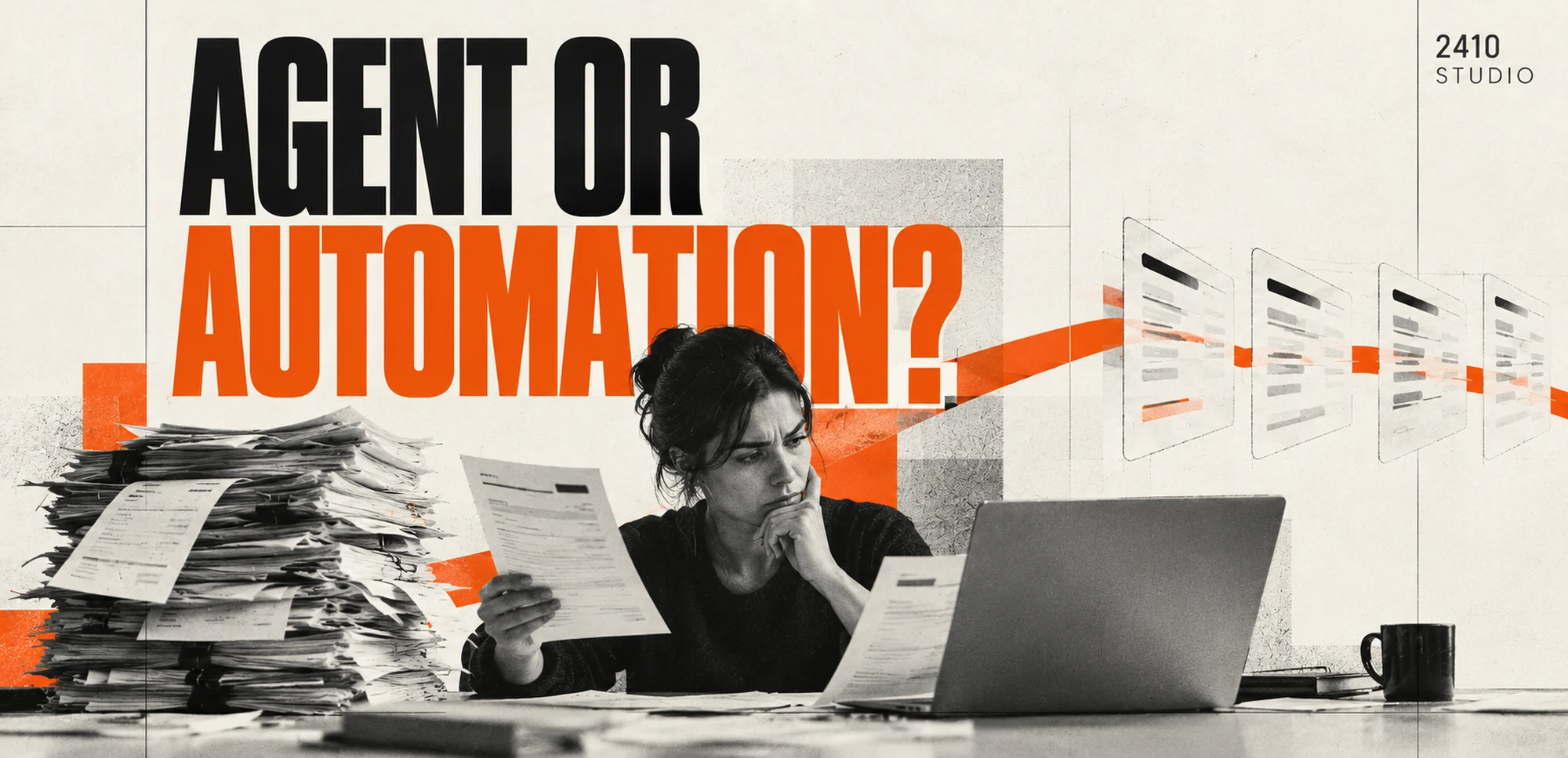
Automation follows defined steps and rules, while an AI agent can choose its next action within agreed boundaries. An AI-assisted workflow can also use AI for one task without becoming an agent. Choose the simplest approach that handles the work, with clear checks for mistakes and human approval for important commitments.
What is the difference between an AI agent and automation?
The difference is how the next step is chosen. In a fixed workflow, the path is designed in advance; in an agent system, AI has some responsibility for choosing actions or tools as the task develops.
Anthropic's explanation of effective agents uses this distinction between predefined workflows and agents directing their own processes. Product names vary, so ask what the proposed system can actually decide rather than relying on its label.
A fixed workflow can still have branches. A form might be routed to different teams depending on a selected service. That is ordinary rule-based behaviour, not evidence that AI is reasoning about what to do next.
Likewise, a workflow can ask AI to summarise a message, then pass the result to a reviewer through predetermined steps. Using AI in one step does not mean the system needs authority to choose an open-ended sequence of actions.
When is ordinary automation enough?
Use ordinary automation when the required action can be reliably described with rules and the input contains the necessary information. Avoid adding interpretation to a task that only needs a dependable connection.
Examples include moving a submitted form into a record, sending an agreed booking confirmation or notifying a team when an approved item changes status. The value comes from doing the defined step consistently, without asking staff to repeat it manually.
Rules do not have to be simplistic. They can check required fields, handle expected exceptions and stop an update when conditions are not met. A well-designed automation should expose failures rather than silently continuing with incomplete information.
Before considering AI, ask whether the input could be improved. A form with clear required fields may eliminate the need to interpret an incomplete email. That change will not fit every customer journey, but it is worth assessing before building a more complex solution.
When might AI assistance or an agent help?
AI assistance may help when language or documents vary and a rigid rule cannot describe the interpretation needed. An agent may be relevant when the task also requires choosing different next actions, within a scope the business can test and control.
Consider three illustrative approaches to an enquiry:
- Automation: Route a form to the team selected by the customer.
- AI assistance: Summarise a free-text enquiry for a person to review.
- Agent: Choose among approved information sources and permitted tools to prepare a more complete response.
These are proposed patterns, not client results. The third option is not automatically better. If a single summary meets the need, additional tool selection may increase the amount of behaviour the business must test and support.
An agent should still have boundaries. Define the sources it can use, actions it can take, when it must stop and what needs approval. A customer-facing assistant should not invent stock availability or prices because the required information is missing.
AI outputs can be wrong, and variable wording can make testing harder than checking a fixed rule. Keep source information available to reviewers and record the relevant actions. Do not assume an agent can safely manage an unfamiliar situation merely because it can produce a confident explanation.
How should you choose the right approach?
Choose by the task's variation, consequences and operating requirements. Compare the complete process, including review and maintenance, rather than choosing whichever tool appears most sophisticated.
Start by writing the task without naming a technology. Describe the input, desired result, destination system and exceptions. Then identify which steps need interpretation and which can be handled by rules. Our AI workflow audit guide explains how to examine that process before building.
For each option, ask what happens when a connection fails, a result is uncertain or the same item arrives twice. Name the person who handles those cases and check whether the proposed tool provides the access and records they need.
Compare full handling time, corrections, unresolved work and operating costs in a limited trial. Include staff review, subscriptions, usage and support. A more flexible system is justified only if it improves the task enough to support the extra effort around it.
Keep high-consequence actions separate. Drafting a response is different from sending it; preparing an invoice record is different from authorising payment. Human approval can be a deliberate part of the design rather than a temporary inconvenience to remove.
2410 Studio is a UK studio that builds AI into the tools a business already uses, with the client keeping custom code. The choice may be ordinary automation, AI assistance or an agent, depending on what the workflow needs. The purpose is supporting the team and improving capacity, not adding complexity for its own sake.
Frequently asked questions
Is every chatbot an AI agent?
No. A chatbot may only answer from supplied information or follow a fixed conversational route. Ask which actions it can choose and which tools it can use.
Can automation and agents work together?
Yes. Defined rules can control intake and approval while AI handles a bounded interpretation step. Keep the responsibilities of each part explicit.
Does an agent remove the need for staff?
No. People still own the process, maintain information, review exceptions and approve important commitments. The amount of review depends on the task and its consequences.
Describe one repeated task and talk to 2410 Studio about the simplest suitable approach. We can help distinguish where rules are enough and where AI could add useful support.
START YOUR INTEGRATION